

West Slopes North
Backcountry Avalanche Forecast
Author: Lee Lazzara
Issued: Saturday, March 14, 2026 at 6:30 PM PDT
Expires: Sunday, March 15, 2026 at 6:30 PM PDT
The Bottom Line
 The Bottom Line
Loose snow avalanches and wind-drifted slabs are again on the menu. Avalanche activity has been limited despite plenty of backcountry traffic, but instability remains, and people have triggered avalanches large enough to carry them down the hill. Avoid steep slopes holding wind-drifted snow. Avalanche danger could increase quickly if strong winds arrive earlier than forecast.
Avalanche Danger
Sunday, March 15, 2026
7500-5500ft2 - Moderate

5500-4500ft2 - Moderate
4500-2500ft2 - Moderate
Monday, March 16, 2026
7500-5500ft4 - High

5500-4500ft3 - Considerable

4500-2500ft3 - Considerable
Avalanche Danger ScaleLearn moreGeneral InfoGeneral Information1 - LowLow2 - ModModerate3 - ConsConsiderable4 - HighHigh5 - ExtrExtreme
 1 - Low | 2 - Moderate | 3 - Considerable | 4 - High |  5 - Extreme | |
|---|---|---|---|---|---|
| Travel Advice | Generally safe avalanche conditions. Watch for unstable snow on isolated terrain features. | Heightened avalanche conditions on specific terrain features. Evaluate snow and terrain carefully; identify features of concern. | Dangerous avalanche conditions. Careful snowpack evaluation, cautious route-finding and conservative decision-making essential. | Very dangerous avalanche conditions. Travel in avalanche terrain not recommended. | Extraordinarily dangerous avalanche conditions. Avoid all avalanche terrain. |
| Likelihood of Avalanches | Natural and human-triggered avalanches unlikely. | Natural avalanches unlikely; human-triggered avalanches possible. | Natural avalanches possible; human-triggered avalanches likely. | Natural avalanches likely; human-triggered avalanches very likely. | Natural and human-triggered avalanches certain. |
| Avalanche Size and Distribution | Small avalanches in isolated areas or extreme terrain. | Small avalanches in specific areas; or large avalanches in isolated areas. | Small avalanches in many areas; or large avalanches in specific areas; or very large avalanches in isolated areas. | Large avalanches in many areas; or very large avalanches in specific areas. | Very large avalanches in many areas. |
Avalanche Problems (2)
Problem #1: Wind Slab
Problem Type
Wind Slab
Aspect/Elevation
Likelihood
Size
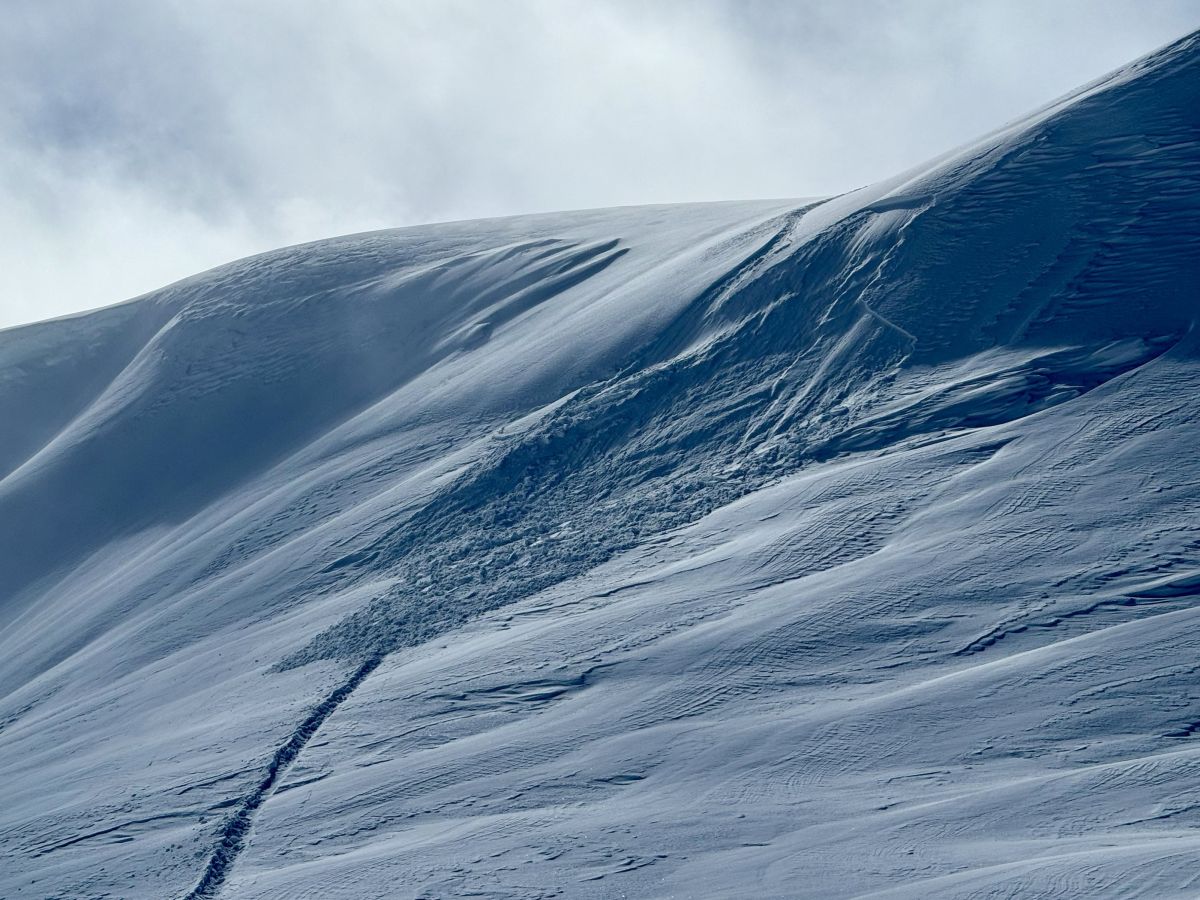
Fresh skier-triggered wind slab on Table Mountain. East aspect at 5400 feet.
(SS-D1-AS-I)
Photo: Zack McGill - Cascade Mountain AscentsLots of steep lines were ridden on Saturday with nary a problem. But there were enough folks out there that a few found slab avalanches in areas that had some amount of wind loading.
While these slab should gain strength, increasing winds in the afternoon ahead of the next storm should get snow moving again and build some fresh slabs. All reported slab avalanhces were just about at the mid-upper elevation boundary of 5500 feet. Expect something similar on Sunday.
Drifting snow will be the main sign of active transport. If the wind isn’t blowing, look for cornices, scoured slopes, and other clues to identify slopes holding wind-drifted snow. Monitor snow depth and stiffness over the crust just below as you gain elevation and change aspects. Small test slopes, hand pits, and other simple tests can help you gauge the bond of new wind slab layers.
Problem #2: Dry Loose
Problem Type
Dry Loose
Aspect/Elevation
Likelihood
Size
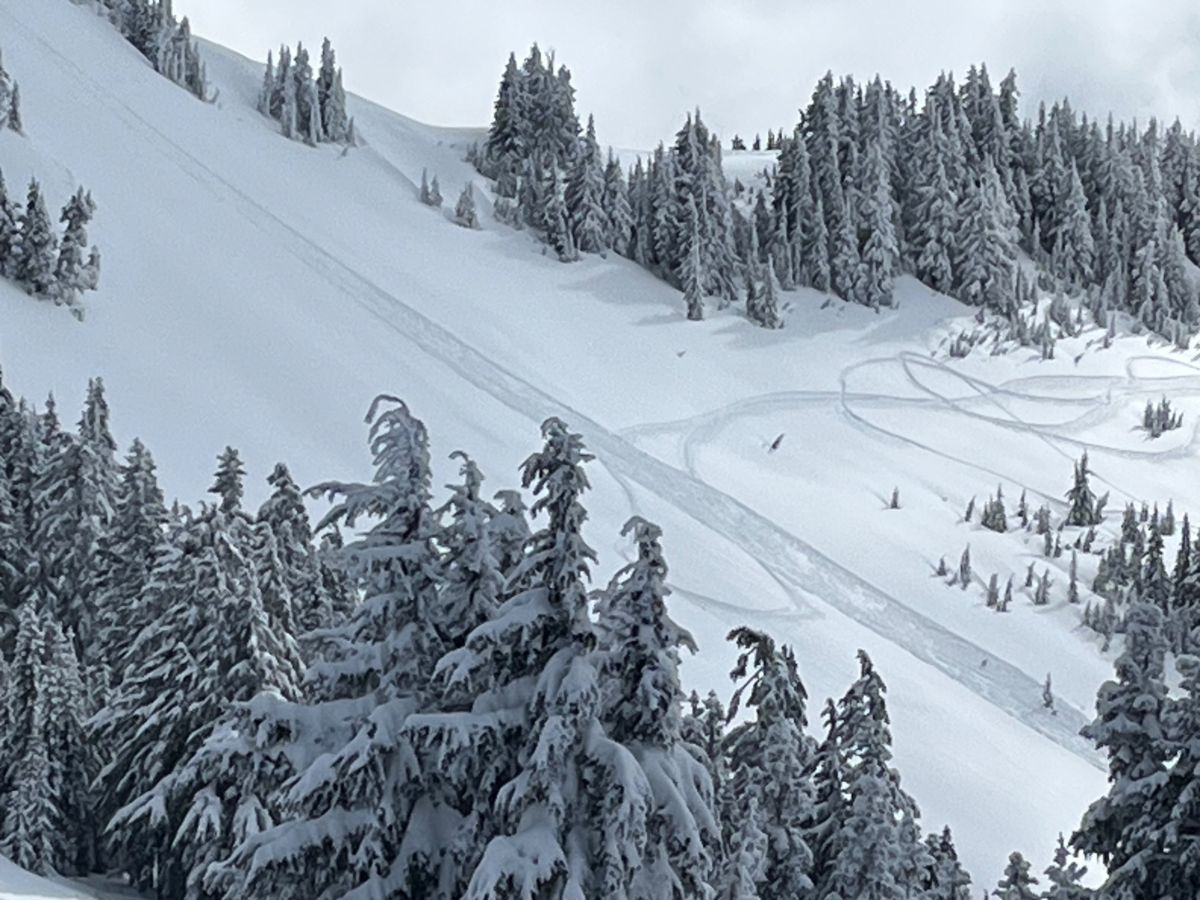
(3/14/2026)
D1.5 Loose avalanche with unknown release time. Canyon Creek. Southwest aspect at 5400 feet.
The snow surface has stayed loose and unconsolidated in areas that haven’t seen wind transport and slab formation. With a crust not to far below the recent new snow, loose snow avalanches have run bigger, faster and farther than normal. The uppermost layer of snow will continue to gain a bit more cohesion with each day, but loose snow avalanches large enough to take you for a ride are still a concern in very steep terrain.
Expect to push some snow downhill with you as you descend or traverse steep slopes. Natural loose dry avalanches are also possible below cliffs and other very steep features. These sluffs are unlikely to bury you, but could push you around or carry you somewhere you don’t want to go.
Forecast Discussion
It was an interesting day in the mountains, with a range of avalanche danger depending on where you chose to play in the snow. An NWAC forecaster in Canyon Creek found no signs of wind effect and a handful of recent natural loose snow avalanches.
In the Baker Backcountry, two separate incidents occurred in which people were caught in loose dry avalanches and carried a short distance. No injuries were reported. A backcountry traveler high on Table Mountain triggered a small, fresh wind slab on a very steep east aspect at roughly 5,500 feet.
The most notable avalanches occurred on Shuksan Arm. In addition to smaller slabs in extremely steep terrain, one party triggered a widely propagating slab that released above a deeper crust layer buried on March 8. Further details are scarce, but this avalanche shows that there is still residual instability at recently buried crust layers. The main ingredient missing on most slopes is a slab stiff enough to propagate a fracture.
With rain on the horizon up into upper elevations, it’s probably not worth diving into the nuances of snowpack structure. The main takeaway is that most slopes are stable, but if you find slightly stiffer snow, you should be on guard. Pick lines with minimal consequences in the runout below in case you get taken by surprise.
This information is provided by the U.S.D.A. Forest Service and describes general backcountry avalanche hazard and conditions.
It does not apply to ski areas and highways where avalanche mitigation is conducted.